
I Contain Multitudes
Book Log
All book logs will be spoiler-free reviews written upon the day of completion. Book logs are meant to be personal accounts of my reading experience and not fully fleshed-out reviews of all aspects of a given book. Take all logs as opinion and not professional craft commentary.

2026.03.06
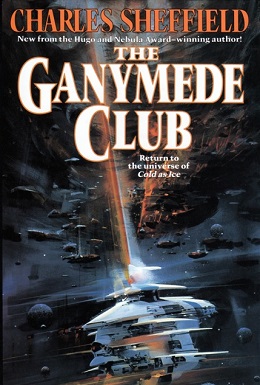
The Ganymede Club by Charles Sheffield | Rating: 4.5/5
The Ganymede Club is the second book set in Sheffield’s solar system civil war world, and follows a very similar structure to Cold as Ice. Upon completion of the first book, I found myself wanting more of the world he’d created and desiring the answers to worldbuilding questions that were opened up in Cold as Ice. The Ganymede Club delivers on all that I wanted. It delves more into the intricacies and atrocities that were devised during the war, as well as the effects of it. Set after the war and before Cold as Ice, Sheffield crafts a story that is just as rich with science and compelling characters. There is a mystery to uncover which I was able to piece together before the big reveal at the end. In similar fashion, The Ganymede Club wraps the mystery up with a nice bow right at the end, with even the same detective stand-in.
It is clear that Sheffield has a favorite character, as he appears in both stories so far, and I have no qualms with it as I am also quite fond of him, despite the continual tasteless fatphobia surrounding his character. If I ignore that, he is one of the most enjoyable characters I have read thus far in both of the books.
I was happier this time around with Sheffield’s writing of women, and the main character is fascinating to me with my psychology background. I am always excited to see the kinds of futuristic advancements that Sheffield dreams up for this system-spanning future world, from the therapy-based to the torture and experimentation.
I did have several small complaints that boil down, yet again, to products of their time. Normally I would not dwell on them, but they took me completely out of the story for a moment. Both near the end, both oddly insistent in their gender essentialism. But like I said, small complaints that ultimately do not affect the larger experience.
This book gets an extra half point from me in my rating because it has 100% more aliens than Cold as Ice.

2026.02.08
This Is How You Lose the Time War by Amal El-Mohtar and Max Gladstone | Rating: 5/5
This Is How You Lose the Time War is, in simplest terms, a time travel love story. In actuality it is so much more than that. It is such an intense read that I had to put it away for a long time before I felt ready to come back to it. I am glad to have finished it now, because I know it is one of those stories that sticks around in one’s soul for the foreseeable future.
Gladstone and El-Mohtar have produced an exemplary collaborative work. It has everything I desire from an epic sci-fi such as this. It has characters worth rooting for, a universe designed to prompt questions and curiosity, and just enough worldbuilding insight to keep you ravenous for more.
As well as being a sci-fi enjoyer, I like stories about love. I would not strictly call this a romance, because in addition to lacking plenty of romance genre tropes, it is more accurately a story about love between the two main characters. It is about love in a universe set upon destroying you for that very same thing. All good sci-fi is a mirror, and this one is polished and clear.
On a technical level, I thoroughly enjoyed the writing style. I believe that on a craft level, there is much a writer (or writers) can do to immerse a reader in a story. I truly feel this world I’m in because the construction of each sentence, each paragraph, and each letter is well-suited to the characters and the world. The abstract language, the creative description, and the subtly vague references to a wide breadth of different time periods and possible futures truly makes this story.
I have no qualms with This Is How You Lose the Time War. It is a recommended read for anyone who will listen to me long enough to let me suggest it.

2026.02.01
Cold as Ice by Charles Sheffield | Rating: 4/5
Cold as Ice is a tale of exploration and mystery set in a solar system post-war that has devastated not only Earth, but Mars and the asteroid belt. Echos of this war color every setting in the story and are embedded in each character we follow.
Sheffield’s expertise as a physicist brings a sharp edge of hard scientific realism to the sci-fi setting of the story, making it a truly immersive world. The ease of understanding is reminiscent of Andy Weir’s scientific writing, blending field-specific jargon with simple explanation to let readers infer intention and importance without hand-holding.
A highlight of Cold as Ice is the integration of single-world politics, expanded to the breadth of multiple populated planets, planetoids, satellites, and asteroids. The individual agendas, bureaucratic systems, and ideological groups are all familiar to us Earth-dwelling readers. Each character has a different role in the politics of their world and it allows great insight into the actual functioning of a large-scale post-war solar system.
Sheffield’s characters have refreshing depth and entertaining interactions with the world and each other. I appreciate stories where characters eventually converge, proving their connectivity and drawing all facets of the narrative together. Sheffield does this effortlessly, though the climactic conclusion of the story is—in comparison to the slower pacing of the rest of the book—perhaps a bit rushed and expositive. Despite this, the mystery aspect of the story was gentle on a newbie and let me feel smart for figuring out key components before they were revealed on-page.
My least favorite elements were products of the time, namely the pervasive fatphobia and perplexing views on women. Science fiction is a genre which consistently impresses me as much as it disappoints me on the more mundane levels of basic compassion. Cold as Ice has a handful of wonderful women who are treated well for the most part, barring several moments which gave me pause and had me wondering about the relevance of the statement. In the same way, the descriptions of any non-thin character were unnecessarily packed with adjectives that had no business in the scene and only drew stark comparisons between the distinct lack of the same description for thin bodies.
Overall, Cold as Ice was a fun read. I enjoyed the science, the politics, and the characters, though I was quickly over the dramatically fatphobic descriptions of one particular character.